🎓 Top 33 Unis
10/12/2026
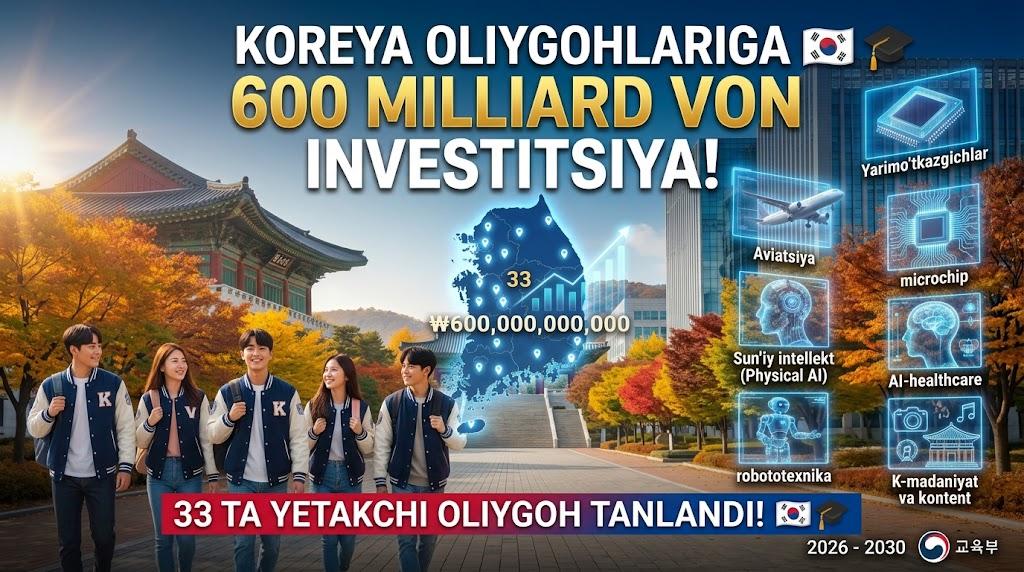
The South Korean Ministry of Education has announced the evaluation results for the "2026 Specialized Leading University Project" (2026년 특성화 선도대학 육성사업), selecting a total of 33 private higher education institutions. This major policy initiative is designed to address demographic shifts, counter regional population decline, and align academic curricula directly with modern high-tech industries and strategic regional sectors.
🏛️ Program Scale and Financial Investment
Project Duration: The initiative spans 5 years from 2026 to 2030, operating on a "2+3" model with an interim evaluation after two years to adjust performance-based funding. Maximum post-project monitoring will continue for an additional 5 years to track sustainable outcomes.
Total Investment: Approximately 600 billion KRW will be invested by the government over the 5-year period.
Initial 2026 Budget: A dedicated 119 billion KRW is allocated for 2026 alone, with 85 billion KRW distributed among 16 four-year universities (averaging 5 billion KRW each) and 34 billion KRW among 17 vocational colleges (averaging 2 billion KRW each).
Capacity and Structural Restructuring: Participating institutions are mandated to reduce overall admission quotas by at least 3% by the 2030 academic year, concentrating previously dispersed resources into high-demand strategic disciplines while guaranteeing educational rights for students in downsizing departments.
⚖️ Regulatory Relief and Institutional Benefits
Selected institutions are designated as "Specialized Regional Universities" under Article 17 of the Regional University Development Act, granting them unique regulatory exemptions (규제특례):
Academic Degree Conferral: Unified university systems (comprising both academic universities and vocational colleges) obtain legal authority to confer specialized associate degrees.
Industry Faculty Recruitment: Exemption from rigid public recruitment processes for non-tenure-track faculty, allowing rapid hiring of industry practitioners, top engineers, and technical researchers.
Campus Infrastructure Flexibility: Regulations regarding property leases, campus grounds, and off-campus instructional facilities are eased to accelerate hands-on industry partnerships.
📋 Full Directory of Selected Institutions & Specializations
🎓 4-Year Academic Universities (16 Non-Metropolitan Universities)
:
Gyeongnam University (경남대): Regional Content IP, Cross-Media production, and integrated community wellness care.
Gyeongwoon University (경운대): Future aviation manufacturing, aviation safety, flight operation, and maintenance networks.
Kosin University (고신대): Bio-health sector integration and practical AI Healthcare curricula.
Gwangju University (광주대): "Human Life" specialization combining care services, public safety, and AI-X platforms.
Daejeon University (대전대): Healthcare, human care, liberal arts cultural design, and national safety/defense.
Tongmyong University (동명대): "BlueX" smart maritime industry combining naval architecture, logistics, and AI/DX.
Dongshin University (동신대): Southwest regional energy value chain focusing on generation, grid management, and utilization.
Mokwon University (목원대): AI and digital convergence in webtoons, animation, and gaming content production.
Pai Chai University (배재대): "K-Defense" technologies, drone robotics, and Physical AI industrial clusters.
Sun Moon University (선문대): Semiconductor materials, advanced packaging, and dedicated student cleanroom FAB facilities.
Silla University (신라대): "AI Well-Life" ecosystem catering to health technologies and aging society solutions.
Woosong University (우송대): Culinary AX, recipe IP digitization, and AIoT automated smart kitchens.
Cheongwoon University (청운대): Agro-industrial complex convergence and lifelong vocational training.
Chodang University (초당대): Future aviation engineering, flight training, and tailored industry employment tracks.
Honam University (호남대): Regional experiential services encompassing tourism, retail distribution, and F&B management.
Howon University (호원대): "K-Culture AX" encompassing stage performance, digital media arts, and capstone design.
🛠️ Vocational & Technical Colleges (17 Metropolitan & Non-Metropolitan Colleges)
:
Gyeonggi University of Science and Technology (경기과학기술대): Manufacturing AX, robotics, and smart factory process integration.
Gumi University (구미대): Industrial robotics, automation, and Physical AI implementation.
Daekyeung University (대경대): K-Performance, stage styling, acting, and digital content production.
Daegu Science University (대구과학대): Digital total healthcare (AX-THC) and wellness care platforms.
Dong-Seoul University (동서울대): Performing arts, media content, and role-based microdegrees.
Baewha Women's University (배화여대): K-Culture lifestyle industries, fashion, culinary arts, and AI/DX applications.
Suwon Women's University (수원여대): Community care, medical rehabilitation, and AI health simulation.
Suncheon Cheil College (순천제일대): Advanced manufacturing, cleanrooms, and semiconductor/Physical AI systems.
Yonam College (연암대): Smart agriculture, automated livestock care, and data-driven farming robotics.
Yeungnam University College (영남이공대): Semiconductor fabrication and Physical AI logistics automation.
Yeungjin University (영진전문대): Advanced machinery, robotics design, and manufacturing lifecycle maintenance.
Yong-in Arts & Science University (용인예술과학대): Semiconductor cluster engineering and AID wellness programs.
Woosong Information College (우송정보대): K-Food, high-end bakery arts, food tech, and corporate internships.
Ulsan College (울산과학대): Secondary batteries, chemical processing, and AX industrial equipment facilities.
Chunnam Techno University (전남과학대): Semiconductor manufacturing infrastructure, smart cleanroom systems, and microdegrees.
Chungbuk Health & Science University (충북보건과학대): Bio-Battery-Chip (BBC) advanced manufacturing and AI engineering.
Hyejeon College (혜전대): Global culinary arts, bakery, and global food tech operations.
🎯 Key Opportunities for International Students
Direct Employment Linkages: Because each curriculum is co-designed with regional industrial clusters and corporate partners, students acquire market-ready skills that significantly increase post-graduation employment rates.
Cutting-Edge Infrastructure: The substantial government funding guarantees direct access to advanced semiconductor FABs, robotics testbeds, smart farms, and cleanrooms rather than purely theoretical instruction.
Flexible Degree Pathways: The introduction of microdegrees, interdisciplinary schools, and accelerated practical certifications allows international students to build versatile resumes recognized by Korean industrial employers.